


PAN Card - Meaning, History, Types, and Importance
A PAN Card is the card issued by the Income Tax Department that carries your Permanent Account Number (PAN), a unique 10-character alphanumeric ID for every taxpayer in India. PAN links all your tax records and high-value financial transactions to one number. You can apply online through Protean or UTIITSL, or get a free instant e-PAN using Aadhaar.

A PAN Card is the card issued by the Income Tax Department that carries your Permanent Account Number (PAN), a unique 10-character alphanumeric ID for every taxpayer in India. PAN links all your tax records and high-value financial transactions to one number. You can apply online through Protean or UTIITSL, or get a free instant e-PAN using Aadhaar.
Read More About - Latest PAN 2.0
What is a PAN Card?
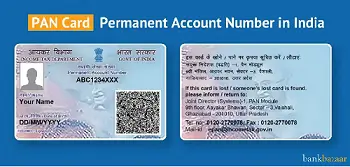
PAN is a 10-digit Unique Identification number. When PAN is allotted to an entity, a PAN Card is provided by the Income Tax Department. While PAN is a number, PAN Card is a physical card that has your PAN as well as the name, date of birth, father’s or spouse’s name, and photograph. Copies of this card can be submitted as proof of identity or date of birth.
History of PAN in India
Before the concept of PAN was introduced, there was a GIR number assigned to taxpayers. This was basically a manual system and was unique only within a ward or under a particular assessing officer. However, the number was not unique at the country level. Since GIR number is not unique, there could be higher chances of miscalculation and errors, or cases of mistaken identity during tax assessment.
The GIR number was allotted by the Assessing Officer to a tax payer and it included the Assessing Officer's information as well.
In the year 1972, the concept of PAN was rolled out by the Indian government and was made statutory under section 139A of the Income Tax Act, 1961. Initially a voluntary process, PAN was made mandatory for all tax paying individuals in 1976.
The initial PAN number allotments were made manually, and to avoid duplication, each ward/circle received a certain set of numbers. This series was abandoned in the year 1995.
Structure of PAN Card
As per the guidelines of Know Your Customer or KYC, the details furnished on a PAN Card are as follows:
1) Name of the cardholder
2) Father’s name of the cardholder
3) Date of Birth of the cardholder
4) 10-character alphanumeric Permanent Account Number or PAN
5) Signature of the cardholder
6) Photograph of the cardholder
7) The PAN Card also comes with the logo and hologram of the Government of India /QR code along with a tag of the Income Tax Department (ITD).
Understanding the Permanent Account Number (PAN)
As mentioned above, the PAN is a combination of 10 characters. This combination can be explained as follows:
- The first 3 characters are alphabetic and can be any combination from the English alphabet.
- The fourth character is also an alphabet which denotes the category of the taxpayer. The categories are as follows:
- A – Association of Persons
- B – Body of Individuals
- C – Company
- F – Firm/Limited Liability Partnership
- G – Government
- H – Hindu Undivided Family
- L – Local Authority
- J – Artificial Juridical Person
- P – Individual
- T – Trust
- The fifth character is also an alphabet and it denotes the first character of the cardholder’s surname.
- The next four characters are numeric and are random in nature.
- The last character is an alphabet again.
Types of PAN Cards in India
PAN Cards are issued to different tax-paying entities. Based on that, the types of PAN are:
- PAN Card for Indian Individuals (including students and minors)
- PAN Card for Indian Companies
- PAN Card for Hindu Undivided Family
- PAN Card for Trusts and Societies
- PAN Card for Limited Liability Partnership
- PAN Card for Association of Persons
- PAN Card for partnership firms
- PAN Card for Body of Individuals
- PAN for Foreign Citizens
- PAN for Foreign Companies
PAN Cards issued to individuals have the person's photograph, name, father's name, date of birth, signature, an authenticity hologram, QR Code, date of issue of the PAN, and the Permanent Account Number. PAN Cards issued to companies have the name of the company, its date of registration, the PAN number, hologram, QR Code, and date of issue of PAN. It will not have a photograph or signature.
PAN Card Eligibility
Under section 262 of the Income-tax Act, 2025, the following taxpaying entities are required to have a Permanent Account Number:
- Any person who has paid tax or is liable to pay tax to the Income Tax Department. This will be decided based on the tax slabs.
- Any person who is carrying out a business or professional practice which earns him a yearly turnover of more than Rs.5 lakh in any year of assessment.
- Importers and exporters who are liable to pay any form of tax or duty charges as per the Income Tax Act or as per any prevalent law
- All kinds of trusts, charitable organisations, and associations.
- All tax paying entities – minors, individuals, HUFs, partnerships, companies, body of individuals, trusts, and others – should apply for PAN.
- PAN eligibility applies to individuals and entities liable to pay tax, conduct business over ₹5 lakh, or engage in import/export or charitable activities.
Why Is a PAN Card Important in India?
- PAN Card is important for taxpayers.
- It is necessary for all financial transactions.
- It is used to track the inflow and outflow of your money.
- It is important when paying income tax, receiving tax refunds, and receiving communication from the Income Tax Department.
How to Apply for a PAN Card?
Given below is the process you will have to follow if you wish to apply for PAN Card online:
- Protean e-Gov Technologies Limited (formerly NSDL)
- UTIITSL
You can also apply offline at any of the district-level PAN agencies. You can apply for a new PAN Card as well as make a correction or change the information yourself. You can even request a duplicate PAN Card or reprint the card if you lose the original.
For new PAN, Indian citizens, including NRIs, need to fill out Form 93, while Indian entities (including companies, NGOs, partnership firms, local bodies, trusts, etc.) need to fill out Form 94. Foreign citizens need to use Form 95 and foreign entities need to use Form 96.
If you have an Aadhaar number linked to your mobile number, you can also get an instant e-PAN through the Income Tax e-filing portal. This service is paperless and free of cost, and the e-PAN issued in PDF format is a valid PAN.
Once you apply for a new or duplicate PAN, or request for corrections/changes, you can track the status of PAN application via the acknowledgement number provided.
How to Apply for a PAN Card Offline?
Given below is the process you will have to follow if you wish to apply for PAN Card offline:
- Visit the nearest PAN centre.
- Fill out the PAN application form.
- Attach your passport-size photo and signature to the application form.
- Submit the application form along with the supporting documents.
- Pay the application fee.
- After verification, the PAN will be sent to your address.
Documents Required to Apply for a PAN Card
To apply for a PAN Card, you will have to submit a host of documents including Form 93, 94, 95 or 96. Given below is the list of required documents for PAN Card you will have to submit while applying for a PAN Card
If you are an Individual Applicant
- Proof of identity such as Aadhaar, Voter ID, Driving License, etc.
- Proof of address such as utility bill, bank account statement, statement of your credit card, Passport, Driving License, Domicile certificate issued by the Government, certificate of marriage, matriculation certificate, etc.
If you belong to a Hindu Undivided Family (HUF)
- You will have to submit an affidavit issued by the Karta of the HUF. The affidavit must clearly mention the name, address, and every coparcener father’s name.
- If you belong to HUF and are individually applying for a PAN Card, then you will have to submit proof of identity, proof of address, and date of birth proof.
For Companies Registered in India
- A copy of the Registration Certificate issued by the Registrar of Companies is to be submitted.
Firms and Limited Liability Partnerships Registered or Formed in India
- A copy of the Registration Certificate issued by the Registrar of Companies is to be submitted.
- A copy of the Partnership Deed is to be submitted.
For Trusts Formed or Registered in India
- You will have to submit a copy of the Registration Certificate Number issued by a Charity Commissioner.
For Association of Persons
- Agreement Copy or Registration Number Certificate issued by the Registrar of Co-operative Society or Charity Commissioner, or any document issued by the Central or State Government which clearly mentions your address and identity.
Applicants who are not Citizens of India
- Proof of identity such as a Copy of PIO issued by the Government of India, Copy of OCI issued by the Government of India, Passport Copy, etc.
- Proof of Address can be bank statement of the residential country, NRE Bank statement, copy of VISA granted by an Indian company, registration certificate issued by FRO, etc.
Uses of PAN in Financial Transactions
- PAN needs to be quoted while paying direct taxes.
- Taxpayers need to input their PAN when paying income tax.
- While registering a business, PAN information needs to be furnished.
- A lot of financial transactions require PAN information. Some of these transactions are:
Check - Uses of PAN Card
General Uses of Having a PAN Card
- Since PAN Card contains information such as Name, Age and photograph, it can be used throughout the country as valid identity proof.
- A PAN is the best possible way to keep track of your tax payment. Otherwise, you might be required to pay it multiple times since your tax payment cannot be verified.
- Since PAN is unique for every entity, its misuse is almost impossible for purposes of tax evasion or other devious means.
- PAN Card can be used to avail utility connections such as electricity bill, telephone, LPG, and internet.
Who Should Get a PAN Card?
Under section 262 of the Income-tax Act, 2025, the following taxpaying entities are required to have a Permanent Account Number:
- Any person who has paid tax or is liable to pay tax to the Income Tax Department. This will be decided based on the tax slabs.
- PAN is mandatory for cash deposits in a bank aggregating to Rs.10 lakh or more in a financial year.
- Importers and exporters who are liable to pay any form of tax or duty charges as per the Income Tax Act or as per any prevalent law
- All kinds of trusts, charitable organizations, and associations.
All tax paying entities – minors, individuals, HUFs, partnerships, companies, body of individuals, trusts, and others – should apply for PAN.
What Happens if you don't have PAN Card?
If your income falls in the taxable bracket, not having a PAN Card would result in:
- Tax deducted at source (TDS) at a higher rate of 20% or more, as stipulated by the Income Tax Department of India. This rule applies to individuals, companies and all entities eligible for tax, including foreign nationals and firms registered outside India.
- Not being able to purchase a motor vehicle worth over Rs.5 lakh, buy immovable property worth over Rs.20 lakh, or open a bank account, among other activities.
- Businesses would be unable to conduct a large chunk of their financial activities and procurement.
- If you do not have a PAN when entering into a transaction that requires one, you will have to file a declaration in Form 97.
*Please note that these rules may change once Aadhaar and PAN become interchangeable.
PAN Card Application Do's and Don'ts
- Fill in all the details as per the identity and address proof documents you are submitting.
- Get your thumb impression attested by a Magistrate/Notary before submitting the form, to avoid disqualification.
- Write the complete address and provide accurate contact details on the form.
- Fill in the application form in capital letters.
- Don't make corrections or over-write anywhere on the form.
- Do not use initials in the first name or last name columns.
- Do not apply for a new PAN Card if your old PAN Card is lost/stolen/defaced. Request for a duplicate PAN instead.
- Foreign citizens and foreign entities should use ‘Form 95’ or ‘Form 96’ when requesting the allocation of a PAN.
- Please attach two recent colour photographs with dimensions of 4.5 cm X 3.5 cm.
- As required by Rule 158 of the Income-tax Rules, 2026, please include proof of identity (POI) and proof of address (POA). The POA must include the address listed on the application.
- Fill out Part E of the application form with the representative assessee's information (if applicable).
- In case Representative Assessee is appointed, provide their identity proof and address proof.
- Include your phone number and email address on the application form.
- Make sure to enter the right ZIP code in the address field.
- Never staple or pin the photograph.
- Never submit address proof or identity proof that are not in the applicant's name.
- Ensure that you are not using initials or abbreviating your name.
- Don't fill in the box with any other information besides your signature, such as a date, designation, rank, etc.
- Make sure to keep your signature inside the box.
A PAN Card acts as an important document which you can use for various purposes. Not only nationally accepted identity proof but it is also an important document when filing income tax (IT) returns. Apart from this it is also used to perform various personal and business transactions.
The following are the list of transactions which can be done only if you have your PAN Card
- Opening a bank account
- Filing your IT returns
- Applying for a loan
- Applying for a gas or telephone connection
- Purchasing or selling a new property
- Getting a debit card or credit card
- Opening a fixed deposit account
- Making insurance premium payments
Legal Implications of Having Multiple PAN Cards
Multiple or duplicate PAN Cards refer to the issuance of more than one PAN Card or PAN number to the same individual. According to Section 262(8) of the Income-tax Act, 2025, a person who has already been allotted a Permanent Account Number cannot apply for, obtain or possess another Permanent Account Number.
It's possible for an individual to unintentionally possess more than one PAN without being aware of it. However, it is not illegal to have two physical copies of the same PAN Card number; the second one would simply be considered a duplicate copy.
Tracking PAN Transactions
The government recently unveiled a programme by which it can track transactions made through a PAN Card for the purpose of calculating tax. Known as the Income Tax Business Application-Permanent Account Number or ITBAN-PAN, it will enable the Income Tax Department to track every transaction made where a particular PAN number was quoted.
- All financial transactions such as mergers, acquisitions, liquidation, and amalgamation of PAN as well as dissolution information where a particular PAN Card was quoted can be traced through the software.
- All existing PAN information and the entire database of PAN information have also been moved to this software.
PAN Card Forms
In order to apply for a PAN Card, an application form has to be filled out. There are four types of application forms – Form 93, Form 94, Form 95 and Form 96. All four forms can be availed through both online and offline platforms.
- Form 93 - The Form 93 is used by Indian citizens to apply for a PAN Card. Students and minors can also apply for PAN using this form.
- Form 94 - The Form 94 is used by Indian entities such as companies, firms, LLPs, trusts and HUFs to apply for a PAN Card.
- Form 95 - The Form 95 is the application form for PAN which is used in the case of foreign citizens.
- Form 96 - The Form 96 is the application form for PAN which is used in the case of foreign entities.
The forms have to be duly filled up and sent to the TIN-Protean e-Gov Technologies Limited's office.
Cost of PAN Application
An individual can make an online application for his or her PAN Card. This can be done through the Protean e-Gov Technologies Limited website (formerly NSDL) or the UTIITSL portal. The cost of application for PAN can be summed as follows:
- For Indian communication address: Rs.93 plus GST.
- For foreign communication address: Rs.864 plus GST.
How to Make Changes or Corrections in a PAN Card?
Given below is the procedure you will have to follow if you wish to make changes or correction to your PAN Card online:
- Visit Protean portal or UTIITSL website
- Select ‘Changes or Correction in existing PAN Data/ Reprint of PAN Card (No changes in existing PAN Data)’.
- Next, enter the relevant details.
- Click on ‘Submit’.
- A token number will be displayed on the screen.
- Click on ‘Continue with PAN Application Form’,
- Enter the relevant details on the next page.
- Choose the way you would like to submit the application form next.
- Next, choose the type of PAN.
- Next, your contact details must be entered.
- Next, the relevant documents must be uploaded.
- Click on ‘Submit’.
- Next, the payment must be made.
How to Apply for a Duplicate PAN Card After Losing the Original?
You will have to follow the steps given below to order a duplicate PAN Card if you have lost your Original PAN Card
- Visit the TIN-Protean e-Gov Technologies Limited (formerly NSDL) or UTIITSL website to apply for a duplicate PAN Card.
- If you are an individual then you will have to submit Form PAN CR-01, otherwise Form PAN CR-02 if you are a non-individual applicant.
- Complete the payment required to apply for a duplicate PAN Card. You can also make the payment via demand draft.
- Take the printout of the form and send to the address given below:
Address - Income Tax PAN Services Unit, Protean eGov Technologies Limited, 4th Floor, Sapphire Chambers, Baner Road, Baner, Pune – 411045
PAN Card Enquiry/Tracking and Online Status Check
- The status of your PAN Card can be checked online after you have submitted the application for it.
- The application status will show you whether the card has been issued or is in transit.
- You can check the status of your PAN Card application on either TIN-Protean e-Gov Technologies Limited or UTIITSL website.
- You can figure out the status of your PAN Card application with your name and date of birth entered on the website.
Which Authority Issues PAN Cards in India?
PAN Card is issued by the Income Tax Department with help from authorized district-level PAN agencies, UTI ITSL (UTI Infrastructure Technology and Services Limited), and Protean e-Gov Technologies Limited (formerly National Securities Depository Limited-NSDL). There are several TIN-Facilitation Centers and PAN centers across the country, run by Protean e-Gov Technologies Limited that help citizens get their PAN Card.
The process of issuing PAN works on the PPP (Public Private Partnership) model. This is done to maintain the economy, efficiency, and effectiveness of managing, processing, and issuing PAN applications.
Permanent Account Number (PAN) for e-KYC
You can use your PAN for e-KYC. e-KYC is a major requirement which is asked for by most service providers and it offers a number of benefits. Some of the benefits of the PAN e-KYC can be summed up as follows:
1) Quick processing: With the help of PAN e-KYC, you can share information with a service provider within a few minutes through dedicated and secured channels. This helps in making the processing quicker.
2) Hassle-free: As it is a paperless process, the PAN e-KYC enables hassle-free management of documents and information.
3) Authorization: The data which is shared through PAN e-KYC is authentic data. This data is legal and nationally acceptable for the parties who are involved in the transaction.
4) Secured data: The data transferred between the cardholder and the service provider cannot be tampered with as they are transferred through secure channels only. In addition to that, the data cannot be used without the consent of both the parties who are involved in this process.
However, it is mandatory to link your Aadhaar and your PAN for the purpose of e-KYC and verification which helps you avail the services and benefits from different service providers.
If your PAN is not linked with Aadhaar, it becomes inoperative. While your PAN is inoperative, no tax refund is made, no interest is paid on refunds for that period, and tax is deducted or collected at a higher rate.
Summary
A PAN Card carries your Permanent Account Number, the 10-character ID that links every tax payment and high-value transaction to you under the Income-tax Act, 2025. Individuals and entities apply using Forms 93 to 96 through Protean or UTIITSL, or get a free instant e-PAN with Aadhaar. Keep only one PAN, link it with Aadhaar and update your PAN Card details whenever they change.
FAQs on PAN Card
1.What is a PAN Card?
A PAN Card is the card issued by the Income Tax Department that carries your 10-character alphanumeric Permanent Account Number along with your name, date of birth, father’s name and photograph. A PAN Card can be used as proof of identity and date of birth across India.
2.How long is a PAN Card valid?
A PAN Card is valid for the lifetime of the PAN holder once the PAN has been allotted. The PAN on your PAN Card does not change even if your address changes.
3.What does the fourth character of the PAN on a PAN Card mean?
The fourth character of the PAN on a PAN Card shows the category of the holder, such as P for an individual, C for a company or H for a Hindu Undivided Family. The fifth character is the first letter of the holder’s surname.
4.Who needs to apply for a PAN Card?
Anyone whose income is taxable, businesses and professionals above the prescribed turnover limit, importers and exporters, and trusts and associations need a PAN Card. Minors, HUFs, firms, companies and other tax-paying entities can also apply for a PAN Card.
5.Why is a PAN Card important?
A PAN Card is important because it links your tax payments, refunds and high-value financial transactions to a single number. Many transactions, such as opening a bank account or buying property, require you to quote the PAN on your PAN Card.
6.How can I apply for a PAN Card online?
You can apply for a PAN Card online through the Protean or UTIITSL portal by filling in the relevant application form, uploading your documents and paying the fee. If your Aadhaar is linked to your mobile number, you can also get a free instant e-PAN through the Income Tax e-filing portal.
7.Which form should I use to apply for a PAN Card?
The PAN Card application form depends on whether you are an individual or an entity and whether you are an Indian or foreign citizen. Indian citizens use Form 93, Indian entities use Form 94, foreign citizens use Form 95 and foreign entities use Form 96.
8.What is the Validity of a PAN Card?
Your PAN Card is valid for a lifetime because it is unaffected by any change in address.
9.How should I fill in the PAN Card application form?
Fill in the PAN Card application form legibly in English, in capital letters and preferably in black ink. Make sure the details match your identity and address proof, and read all instructions before filling out the form.
10.Can I apply for a PAN Card on plain paper?
No, a PAN Card application written on plain paper is not accepted. You must use the application form notified by the Central Board of Direct Taxes.
11.What documents are required to apply for a PAN Card?
Individual applicants need proof of identity, proof of address and proof of date of birth to apply for a PAN Card. Companies, firms, trusts and other entities need their registration certificate or equivalent documents, as listed in the documents section above.
12.Should a married woman give her father’s name in the PAN Card application?
Yes, all female applicants should give only their father’s name in the PAN Card application, irrespective of their marital status. The husband’s name is not required on the form.
13.Is it mandatory to give my email ID or phone number in the PAN Card application?
Yes, you should give your email ID or phone number in the PAN Card application so that you can be contacted if there is a discrepancy. It also helps you receive your e-PAN by email.
14.Will I get an acknowledgement after submitting my PAN Card application?
Yes, you receive an acknowledgement with a unique acknowledgement number when you submit your PAN Card application. You can use this number to track the status of your PAN Card application.
15.How can I correct the details on my PAN Card?
You can correct your name, date of birth, photograph or other details on your PAN Card by submitting a change or correction request through the Protean or UTIITSL portal. The updated PAN Card is then dispatched to your address.
16.How do I get a duplicate PAN Card if I lose the original?
If you lose your PAN Card, request a reprint or duplicate PAN Card instead of applying for a new PAN. You can submit this request online through the Protean or UTIITSL portal.
17.Can I hold more than one PAN Card?
No, a person who has already been allotted a PAN cannot apply for, obtain or possess another PAN under the Income-tax Act, 2025. Holding more than one PAN can attract a penalty from the Income Tax Department.
18.Who issues PAN Cards in India?
PAN Cards are issued by the Income Tax Department with the help of Protean eGov Technologies Limited and UTIITSL. These agencies run PAN centres and TIN-Facilitation Centres across the country.
19.Can I use my PAN Card for e-KYC?
Yes, you can use your PAN Card details for e-KYC with service providers, which makes verification quick and paperless. Your PAN must be linked with Aadhaar to use it for e-KYC and verification.
PAN Card News
Income-tax Rules 2026 Bring Major Change: PAN Needed for Important Post Office Services
The Income-tax Rules, 2026 state that if a depositor does not have a PAN, the post office must obtain Form No. 97 from them. This form must contain the depositor's name, address, transaction amount, and any supporting documentation. Forms 15G and 15H, which were filed by people to avoid TDS on interest income, including post office investments, will now be replaced by a single Form 121. Additionally, Form 60, which was utilized when a person lacked PAN, has been replaced by Forms 97 and 98. It is necessary to file a declaration in Form No. 121 for each tax year separately.
Changes in PAN Card Application Rules from 1 April 2026
The government has introduced stricter rules for PAN card applications, effective from 1 April 2026. As per the new rules, Aadhaar will no longer be sufficient as the sole document for PAN applications. Applicants will be required to submit additional documents such as a birth certificate, voter ID, passport, driving licence, affidavit, and Class 10 certificate. Applicants can continue to apply for a PAN card using only Aadhaar until March 31, 2026.
The government is also replacing the current PAN application forms with newly introduced forms. Moreover, if the name on your PAN card does not match the name on your Aadhaar card, your PAN card may be deactivated.
Draft Income Tax Rules 2026: Stricter Reporting for Cash Transactions and Investments
The Income Tax Department has announced a revised set of draft income tax rules; once completed, they will be effective for fiscal year 2026-2027. Changes to the draft income tax rules will impact your income tax payment, cash withdrawal, cash payment, and more. Additionally, you will need to provide your PAN card number for a number of transactions. The draft guidelines were published, and the government requested comments from interested parties by 22 February 2026. The new regulations will be adopted, made public, and set to go into effect on 1 April 2026, once the submitted replies have been reviewed. When depositing more than Rs. 50,000 in cash in a single transaction at a bank or post office; current requirements require that a PAN be presented.
Government Proposes Easier PAN Rules for Daily Transactions
The government has proposed new PAN card rules under the draft Income Tax Rules, 2026, which are open for public feedback and will take effect from 1 April 2026, along with the Income Tax Act, 2025. Under the proposal, PAN will be required for cash deposits or withdrawals only if the total amount is Rs.10 lakh or more in a financial year, instead of the current rule that requires PAN for cash deposits above Rs.50,000 in a single day. For vehicle purchases, PAN will be needed only if the vehicle costs more than Rs.5 lakh, while at present it is mandatory for all vehicle purchases. The PAN limit for hotel, restaurant, and event payments will increase from Rs.50,000 to Rs.1 lakh. In property deals, PAN will be required only for transactions above Rs.20 lakh, compared to the current Rs.10 lakh limit. PAN will also become compulsory for opening an insurance account. If approved, these changes are expected to make small transactions easier while keeping strict checks on high-value deals.

Disclaimer
Credit Card:
Credit Score:
Personal Loan:
Home Loan:
Fixed Deposit:


Copyright © 2026 BankBazaar.com.